
 Skip to content
Key Account Intelligence
Know What is Changing
Inside the Accounts Your
Revenue Depends On
Cognition continuously monitors your strategic accounts to uncover changes in priorities, leadership, investment, buying dynamics, and competitive activity – then translates those signals into clear commercial implications and actions for account teams.
What It Solves
Account Intelligence Decays Faster Than Most Teams Realise
What you knew about an account last quarter is already out of date.
Strategic accounts rarely stand still. Priorities shift, stakeholders move, investments change, and competitors gain ground – often within weeks, not quarters. Yet account plans and CRM data are typically updated on a periodic cycle, refreshed at renewal, at QBR, or whenever someone finally finds the time. In between those updates, the account keeps evolving while the record of it stays frozen. Teams end up making commercial decisions – where to invest effort, who to engage, what to pitch next – based on a view of the account that’s already several steps behind reality.

Stale account views
CRM records, account plans, and research snapshots capture a moment in time. They rarely reflect how the account is evolving – who now influences decisions, which priorities are gaining importance, and where new opportunities or risks are emerging.

Undetected account shifts
Leadership changes, investments, reorganisations, strategic initiatives, and competitor activity can reshape an account quickly. When these developments go undetected, businesses respond late and opportunities can disappear before they are recognised.
Disconnected account intelligence
Knowing what changed is not enough. Teams need to understand why it matters, how it affects the account, and what action to take. Without that interpretation, valuable intelligence remains disconnected from account strategy.
How it Works
Each Engagement Begins with a Scoped Diagnosis
We start by defining what matters before we start monitoring anything.
Before any monitoring begins, we work with you to define which accounts matter most and why, which commercial decisions the intelligence actually needs to support, and who on your team will use it day to day. Just as important is how it fits: intelligence that lives inside your existing account workflow gets used; intelligence that sits alongside it as a separate tool or report usually doesn’t. That scoping upfront is what makes everything downstream – the monitoring, the analysis, the action plans – actually relevant to how your teams work.
Four connected intelligence layers:
- Account anatomy – Business structure, financial context, strategic priorities, operating divisions, and relevant market exposure.
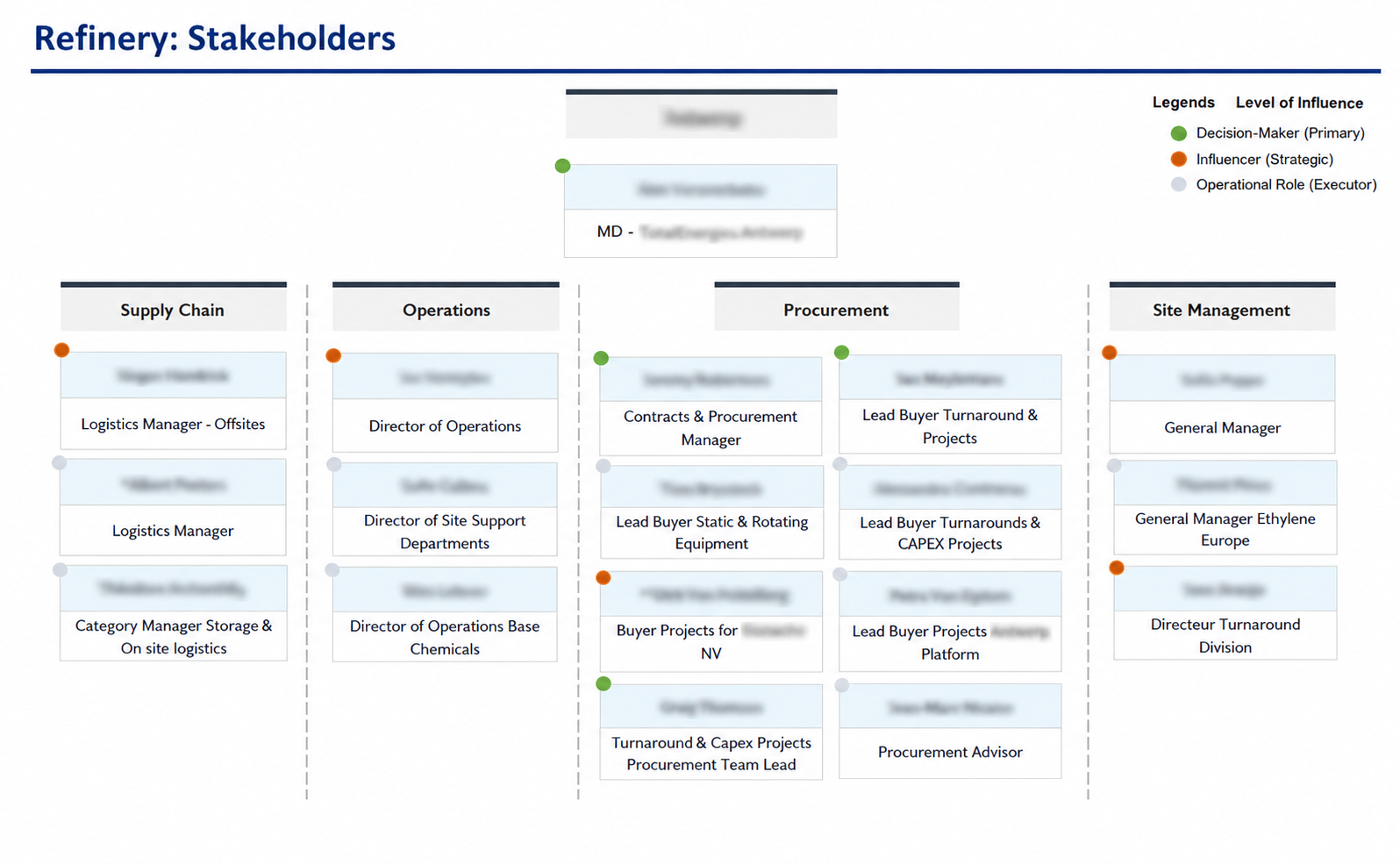
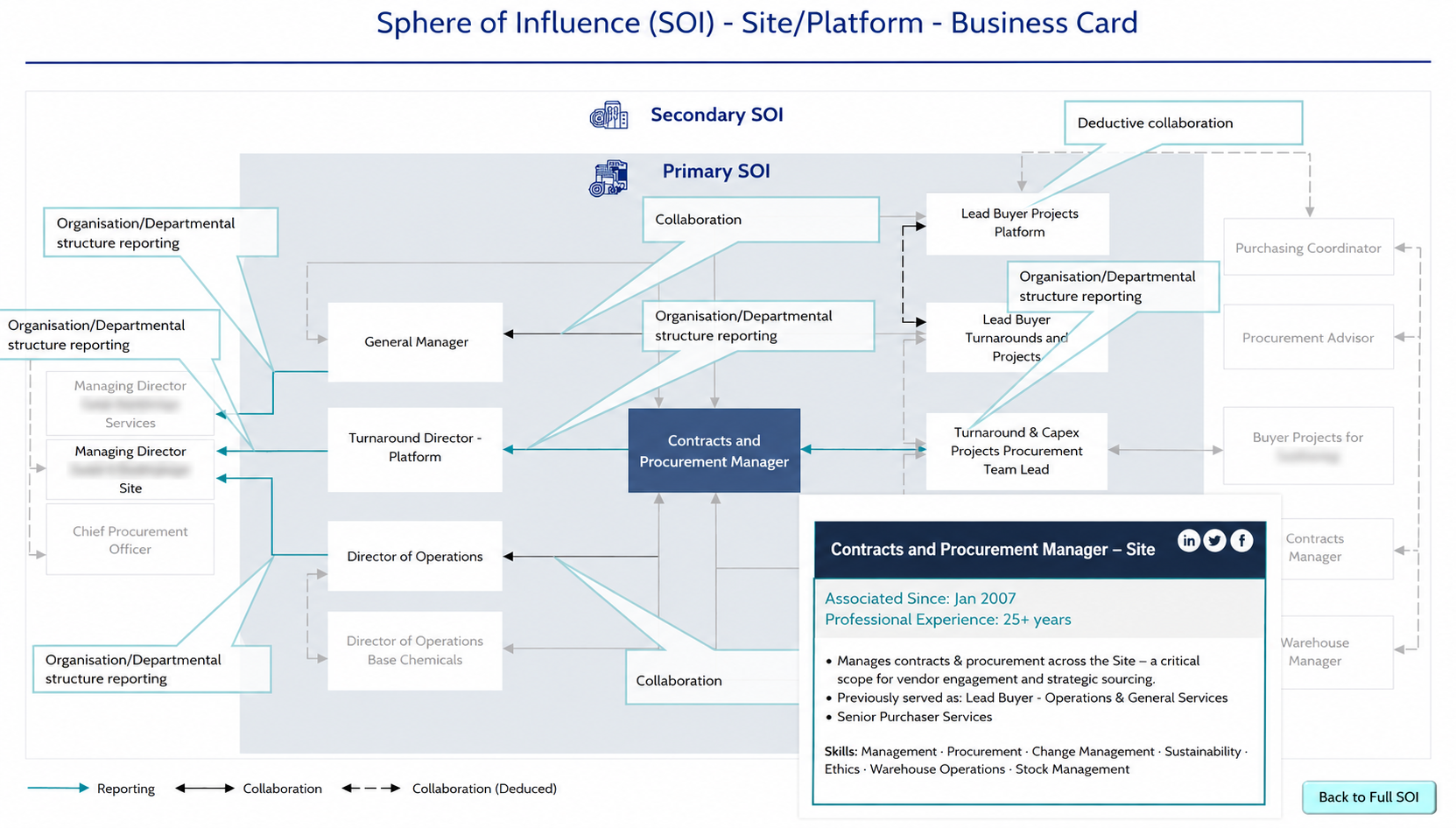
- Decision and influence mapping – Buying-centre roles, reporting relationships, decision authority, stakeholder influence, and named-contact intelligence.
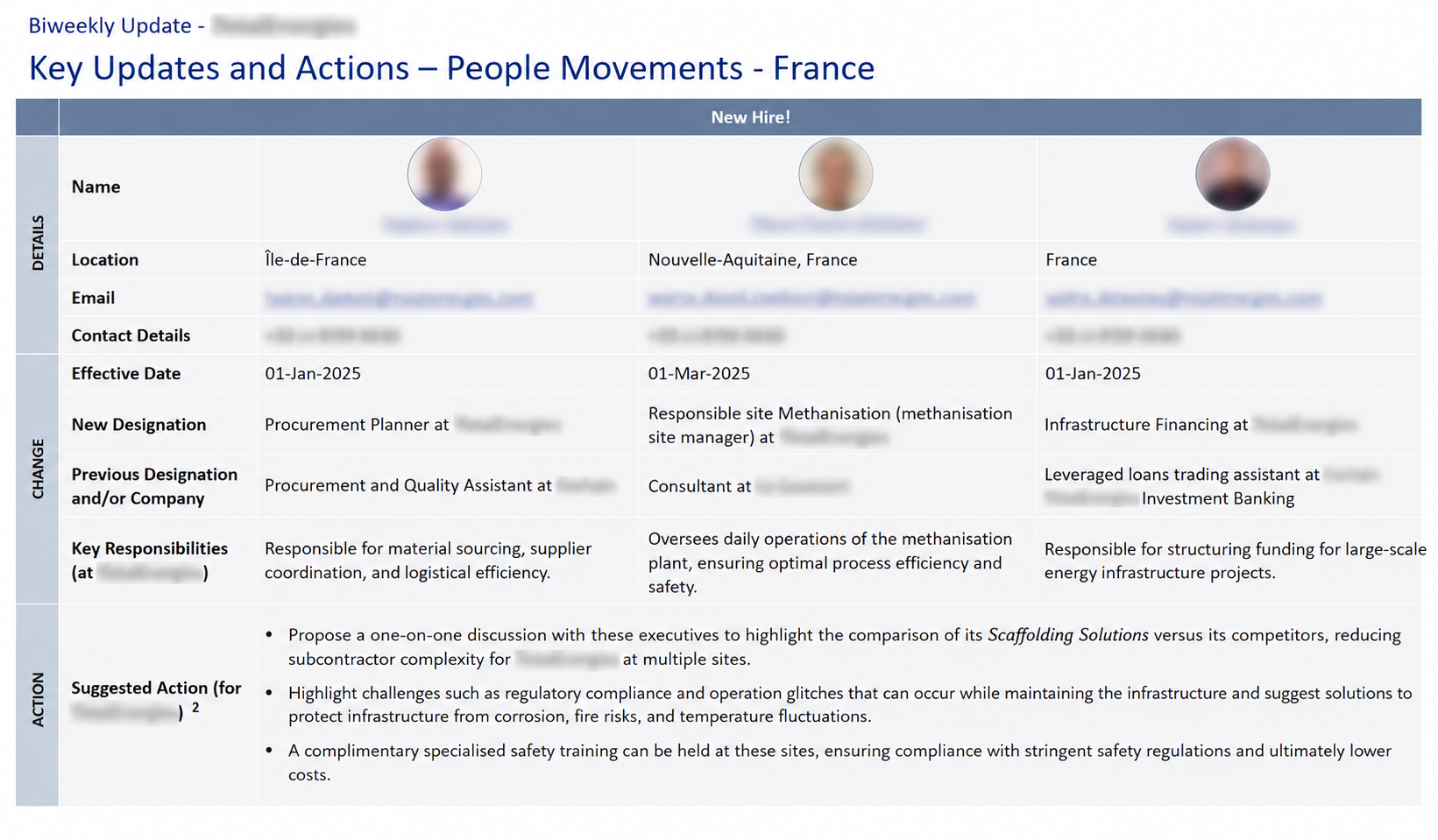
- Continuous change detection – Leadership movements, investment, innovation, hiring, regulation, M&A, sustainability activity, and competitive developments.
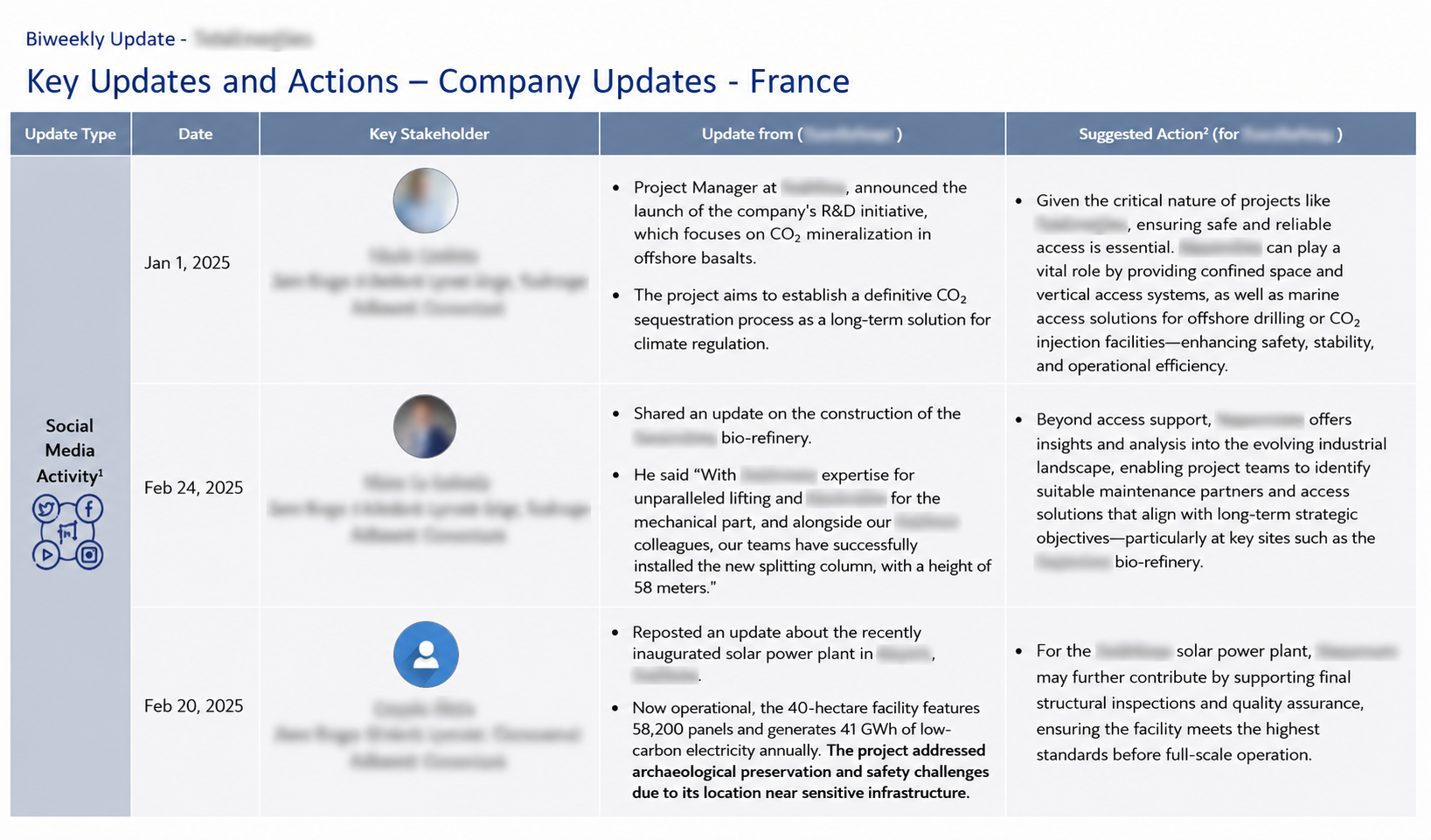
- Commercial interpretation and action – What changed, why it matters, the opportunity or risk it creates, who should be engaged, and the recommended entry angle.
Three operating speeds:
- Quarterly intelligence refreshes – Maintain the underlying account picture as strategies, structures, priorities, and stakeholders change.
- Continuous monitoring – Identify material developments as they emerge across priority accounts through daily signal monitoring.
- Fortnightly or trigger-based action plans – Translate significant developments into their commercial implications and recommended actions.

Where the hidden cost shows up
The issue is not always the tool.
Often, it is the foundation the tool is being asked to act on. Select a card to see how the data layer constrains GTM performance.
Domain damage
Opportunity tax
Revenue gap
People moves
AI underperformance
AI-assisted outreach only performs as well as the account and contact intelligence it inherits. If that intelligence is wrong, AI makes the wrong action look polished.
Enterprise Intelligence That Stays Current

Built around your commercial motion
Each key account is treated as its own market, not a template. The intelligence architecture is configured around your product set, account priorities, and the specific decisions your teams need to make, rather than a generic research format applied uniformly across clients.

AI-powered, analyst-led
Automation handles source monitoring and orchestration at scale. Experienced analysts validate accuracy, interpret context, and determine what is commercially relevant, so teams receive judgement, not just data volume.

Maintained, not delivered once
Account structures, stakeholder maps, and signal feeds are refreshed on an agreed operating cadence. Intelligence stays current by design, rather than decaying after a single research exercise the way most account profiles do within a quarter.

Sector-fluent analyst teams
Analysts bring working familiarity with the sectors they cover, industrial services, energy, life sciences, enterprise technology, financial services, and other complex B2B markets, so context and interpretation are grounded in how those industries actually make decisions.
Client Stories

Client Story
Scaled to 400+ key accounts, achieved 40% solution adoption, and expanded market coverage by 35% while strengthening customer trust.

Client Story

Client Story
Projected 23% ARR growth, improved lead conversion by 15%, and expanded market reach by 30% across additional pharmaceutical firms.

Client Story
Increased client retention by 34%, grew key account revenue by 28%, and expanded active intelligence coverage to 300+ additional accounts.
Do You Know What’s Changing Inside Your Key Accounts?

 Hi, This is Emma. Let’s get the conversation started!